
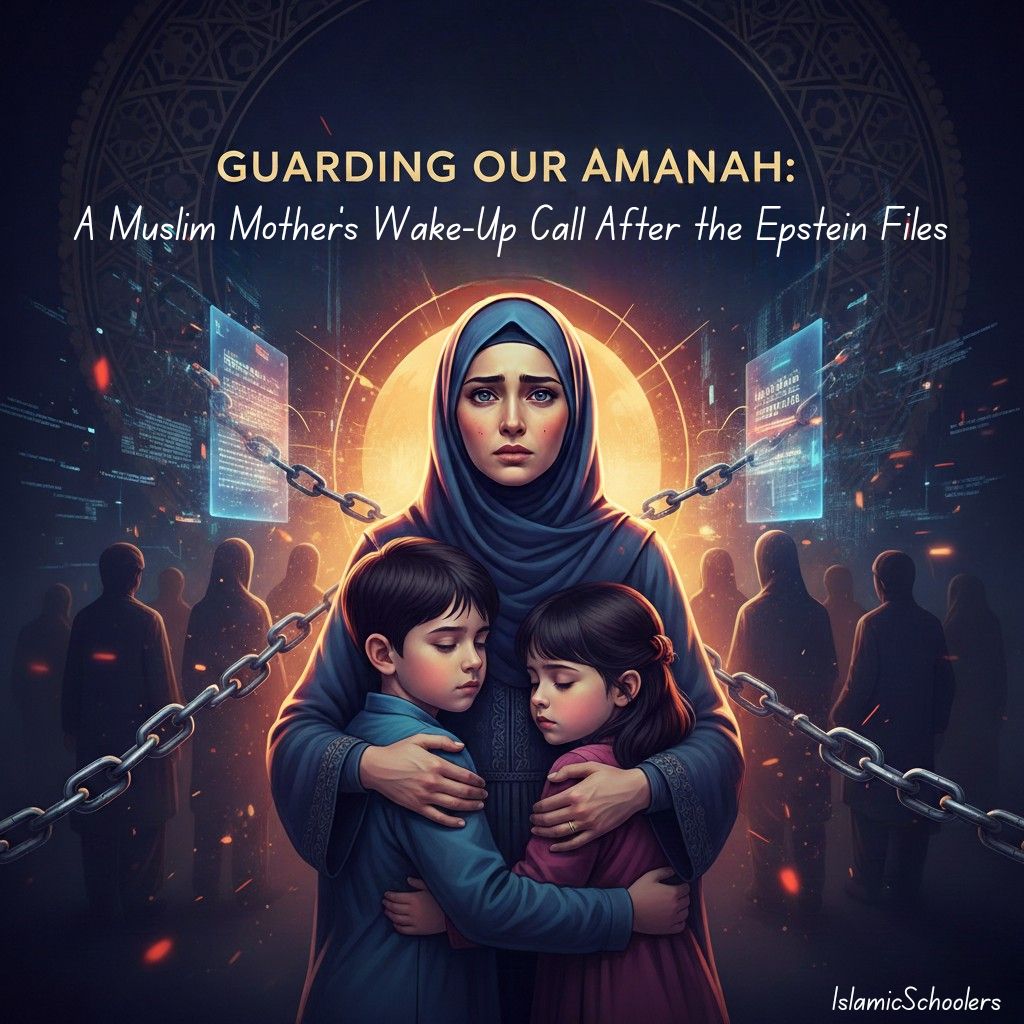
When I first began hearing conversations about the Epstein files, I felt something shift inside me. Not curiosity. Not political interest. But a deep, maternal unease.
Because when the world uncovers organized exploitation, especially involving the powerful and wealthy, it forces a painful realization: evil does not always look frightening. Sometimes it is polished. Sometimes it is respected. Sometimes it hides behind influence and connections.
And as a Muslim Pakistani homeschooling mother, that realization shook me. The Epstein files are not just news headlines. They are a reminder that corruption can operate quietly for years. That victims can be silenced. That systems can fail. That prestige does not equal morality.
And if that is true, then protecting our children cannot be passive. It must be intentional. It must be informed. It must be rooted in our deen.
Why This Feels Personal, Even From Far Away:
Some may think, “This is Western news. Why should we bring it into our homes?” But the issue is not geography. The issue is influence. Our children live in a globally connected world. Even if we homeschool. Even if we monitor devices. Even if we limit exposure. Trends travel through reels, short clips, conversations, and algorithms that do not ask for our consent.
When something like the Epstein files becomes widely discussed, children hear fragments. They see reactions. They sense tone. Even if they do not know the details, they absorb the normalization of the topic.
And that is where my concern begins. Islam teaches us to avoid spreading indecency:
“Indeed, those who love that immorality should be spread among the believers will have a painful punishment…” (Surah An-Nur 24:19)
We are not meant to consume scandals as entertainment. But we are meant to take lessons from what they reveal. And what this reveals is simple and frightening:
Exploitation can be hidden behind power. Wrong can be protected by status. Victims can be ignored for years. If such corruption can survive at elite levels, then we cannot assume our children are automatically safe simply because we are distant. Fitna does not require physical presence. It spreads through culture. Through normalization. Through silence.
The Hidden Layers of Fitna Behind It:
As I reflected deeper, another worry began to settle in my heart. When societies begin to blur moral boundaries in one area, they often begin to blur them in others. When indecency becomes tolerated at high levels, it creates an environment where all forms of moral confusion start being defended under the language of “freedom,” “identity,” or “progress.”
Today, our children are growing up in a climate where:
- Biological realities are questioned.
- Same-sex relationships are presented as morally equal to the natural family structure.
- Gender confusion is introduced at younger ages.
- Modesty is criticized as repression.
- Islamic boundaries are labeled as outdated.
As Muslims, we are commanded to treat every human being with dignity and justice. But we are not allowed to redefine what Allah has clearly defined.
Allah says:
“Do not follow desires if they deviate you from the path of Allah…” (38:26)
And He created humanity with clear wisdom in male and female:
“And of His signs is that He created for you from yourselves mates…” (30:21)
When moral confusion becomes mainstream, children are the most affected. They are impressionable. They are searching for identity. They are vulnerable to emotional narratives that present rebellion as empowerment.
The Epstein files revealed exploitation hidden behind influence. But what disturbs me equally is how moral boundaries in general are being steadily erased in the name of acceptance and equality, without acknowledging the spiritual and psychological consequences. When everything becomes “normal,” children lose clarity. And without clarity, they lose direction.
The Quiet Danger; Losing Sensitivity:
The greatest fear in my heart is not that my child will read a headline. It is that repeated exposure will slowly reduce their sensitivity toward wrong.
The Prophet (PBUH) described how trials enter the heart gradually:
“Trials will be presented to the hearts as a reed mat is woven stick by stick…” (Muslim)
One exposure. One conversation. One normalized reaction. Until something that should shock the soul becomes “just another story.”
Islam protects hearts through haya, a deep sense of modesty and moral consciousness. The Prophet (PBUH) said:
“Modesty is part of faith.” (Bukhari & Muslim)
Haya creates a natural barrier. It makes the heart uncomfortable with indecency. It prevents curiosity from becoming carelessness.
But when society repeatedly discusses exploitation casually, when serious crimes are debated like celebrity gossip, that natural barrier weakens. As mothers, we cannot allow our children’s hearts to become numb.
Homeschooling: A Responsibility, Not Just a Choice:
When I chose homeschooling, I chose proximity. I chose to be present in my children’s intellectual and emotional formation. I wanted their worldview shaped by Qur’an before it was shaped by trends.
But the Epstein files reminded me that proximity without vigilance is not protection. Homeschooling does not automatically filter the digital world. It does not automatically build discernment. It does not automatically protect innocence.
I must actively:
- Observe emotional changes.
- Notice increased secrecy around devices.
- Pay attention to shifts in language or curiosity.
- Create space for uncomfortable conversations.
Protection is not fear-based control. It is value-based guidance.
What We Must Teach: Without Spreading Indecency:
We do not need to describe scandals in detail. In fact, Islam discourages unnecessary exposure to such content. But we must equip our children with principles that prepare them.
1. The Sacredness of the Human Body
Our children must understand that their bodies are an amanah from Allah.
This means:
- No one has the right to cross physical boundaries.
- Respect is non-negotiable.
- Popularity, wealth, or authority do not justify inappropriate behavior.
When children internalize sacredness, they are less likely to be manipulated by charm or influence.
2. Haya as Strength
In a world where shamelessness is often celebrated, we must reframe modesty as dignity. The Prophet (PBUH) was described as extremely modest. That modesty did not weaken him; it elevated him.
We must teach our daughters that covering is honor. We must teach our sons that lowering the gaze is strength. We must teach both that self-control is nobility.
3. Emotional Safety at Home
One painful pattern in exploitation cases revealed through the Epstein files is silence. Silence protects predators. Silence isolates victims. Our homes must be the opposite.
Our children should know:
- If something online makes you uncomfortable, come to me.
- If someone says something inappropriate, tell me.
- If you feel confused, I will not shame you.
If they fear our reaction more than the problem, they will hide the problem. And hidden problems grow.
The Spiritual Shield We Cannot Ignore:
No strategy is complete without du’a. The Prophet (PBUH) used to seek protection for children with these words:
“I seek refuge for you in the perfect words of Allah from every devil and every harmful thing…” (Bukhari)
As mothers, we must:
- Recite Surah Al-Falaq and An-Nas over them.
- Encourage daily salah, even gently and gradually.
- Fill our homes with Qur’an recitation.
- Teach them to say Bismillah before opening devices.
- Make du’a in tahajjud when no one sees our tears.
Spiritual negligence creates vulnerability. Spiritual consistency builds armor.
A Wake-Up Call, Not Panic:
The Epstein files should not make us paranoid. But they should remove complacency. They remind us that:
- Wealth does not equal righteousness.
- Status does not equal safety.
- Systems do not equal morality.
Only Allah protects. But Allah also commands effort.
“And take provisions, but indeed, the best provision is righteousness…” (2:197)
Righteousness must begin at home.
From One Concerned Mother to Another:
Sisters, our children are growing up in an era where moral lines are being redrawn daily. What was once hidden is now debated publicly. What was once shameful is sometimes defended.
We cannot control the world. But we can control the climate of our homes.
- Guard their screens.
- Guard their conversations.
- Guard their sense of haya.
- Guard their understanding of dignity.
Let the world analyze the Epstein files. We will analyze our parenting. Our vigilance. Our du’as. Our consistency. Because one day, our children will stand before Allah independently. And we will stand before Him as mothers who were entrusted with hearts.
May Allah protect our sons and daughters from every hidden and apparent trial. May He preserve their innocence, strengthen their faith, and make us mothers who are awake, wise, and courageous.
Ameen.