
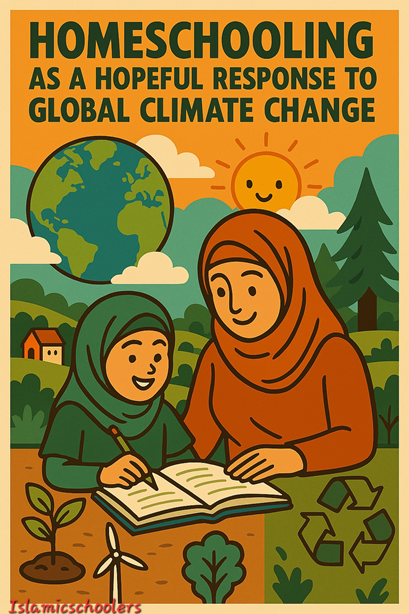
Raising Earth-Conscious Children Starts at Home:
A rising sun cuts through layers of haze. The trees no longer hum with life as they once did. The rivers are warmer. The skies are louder. Yet, amidst the silent warning signs of a planet in distress, something deeply powerful is happening behind closed doors, at kitchen tables, in backyards, and on morning walks. Families are turning to homeschooling not only as an academic alternative but as a meaningful response to global climate change.
As environmental concerns become louder, more and more parents are asking: What kind of world are we preparing our children for? And perhaps more importantly, What kind of children are we preparing for this world?
Climate Change and the Urgent Need for Mindful Education:
From record-breaking heatwaves to shrinking glaciers, the impact of climate change is no longer a distant threat. It’s personal. It’s local. And it’s happening now. Every year, floods uproot homes, wildfires claim forests, and droughts steal the laughter from once-fertile lands. Yet, many traditional education systems remain slow to adapt.
Standard curriculums often touch on environmental topics as side lessons, packed between exam syllabi and memorized facts. But when the planet is gasping for breath, shouldn’t education become a tool of healing, awareness, and action?
That’s where homeschooling steps in, not as a step back, but a powerful step forward.
Why Homeschooling is a Natural Ally in the Fight Against the Climate Crisis:
Homeschooling gives families something traditional classrooms often cannot: freedom of intention. Every subject, science, geography, language, even math, can be laced with environmental awareness. Lessons don’t end at the whiteboard; they flow into composting bins, garden beds, recycling sessions, and quiet moments under the sky.
Parents and children can slow down to notice the changes around them, the brown patches on the lawn, the declining bird songs, the shifting winds, and ask why. This kind of education builds not only knowledge but empathy. And empathy creates change-makers.
Homeschoolers can adapt quickly to integrate eco-literacy, climate action projects, documentaries, nature journaling, and even field trips to conservation sites. Instead of just learning about carbon footprints, they calculate their own. They don’t just memorize endangered species, they start projects to protect local ones.
Climate-Conscious Curriculum Ideas for Homeschooling Families:
Here are a few powerful ways homeschooling can contribute to building climate-resilient children:
Nature-Based Learning: Use outdoor settings as your classroom. Teach biology through local flora and fauna, and observe seasonal changes firsthand.
Zero-Waste Challenges: Involve kids in weekly zero-waste goals, like replacing plastic items or creating DIY natural products.
Green Math Projects: Turn math lessons into real-world challenges like calculating water usage, electricity bills, or food miles.
Storytelling with Purpose: Include stories of environmental heroes, indigenous knowledge keepers, and youth climate activists as part of language and reading lessons.
Science That Matters: Create experiments on soil erosion, water filtration, plant growth, and climate patterns to spark curiosity and awareness.
Teaching Responsibility, Resilience, and Reverence:
Like I always say, homeschooling isn’t just about academics. It’s about character. Climate change is not only a scientific issue, it’s deeply human. It requires a generation that is not just informed but emotionally grounded, spiritually aware, and morally committed.
At home, children can learn to fix before they throw, grow what they eat, walk when they can, and reuse creatively. They learn that their small decisions ripple outward, into ecosystems, communities, and future generations.
When children grow up knowing they have the power to heal even a small corner of the Earth, they begin to walk this world differently, with purpose, gratitude, and quiet courage.
A New Legacy: Raising Earth-Keepers, Not Just Earth-Dwellers:
Global climate change is the greatest challenge of our time, but it’s also the greatest teacher. It asks us to reimagine not just how we live, but how we learn. Homeschooling is one of the rare paths where this reimagination feels possible, personal, and powerful.
Through homeschooling, families are not escaping the climate crisis, they are preparing for it, responding to it, and building strength in the next generation. These aren’t just lessons. These are legacies.
Let us raise children who do not ask “What can I take from the Earth?” but “What can I return to it?”