
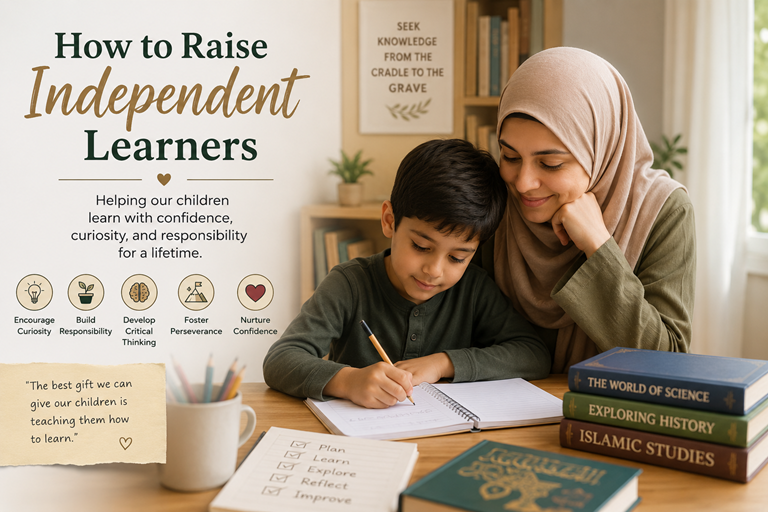
When I first started homeschooling, I thought my job was to teach my children everything. I planned lessons, printed worksheets, explained concepts, corrected mistakes, and carefully guided every step of their learning. I believed that a successful homeschool day was one where I had all the answers and my children followed my instructions perfectly.
But over time, I realized something important. The goal of education is not to create children who depend on a teacher for every answer. The goal is to raise children who know how to learn for themselves. As mothers, we often carry the weight of our children’s education on our shoulders. We want them to succeed, so we help, remind, explain, and sometimes even rescue them when things become difficult. While this comes from love, too much help can unintentionally prevent our children from developing one of the most important skills they will ever need: independence.
An independent learner is not simply a child who studies alone. It is a child who asks questions, seeks solutions, takes responsibility for learning, and continues growing even when no teacher is watching.
Why Independent Learning Matters:
The world our children are growing up in is changing rapidly. Information is available everywhere. New careers are emerging. Technology evolves almost daily. In such a world, memorizing facts is no longer enough. Children need to know how to find information, evaluate it, understand it, and apply it. They need the confidence to explore unfamiliar topics and the perseverance to keep learning throughout their lives.
More importantly, as Muslim parents, we want our children to become seekers of knowledge. Islam encourages curiosity, reflection, and lifelong learning. The first revelation to our beloved Prophet Muhammad (PBUH) began with a command to read. When we nurture independent learners, we are helping our children develop a love for knowledge that extends far beyond textbooks and examinations.
Allow Questions to Lead the Learning:
One of the greatest gifts we can give our children is the freedom to ask questions. Children are naturally curious. They wonder why the sky changes colors, how birds fly, where rain comes from, and why people live differently around the world. Instead of immediately providing every answer, try responding with another question:
“What do you think?”
“How could we find out?”
“Where can we look for that information?”
These simple responses teach children that learning is not about receiving answers, it is about discovering them. Some of the best learning moments in our home began with a simple question that led us down an unexpected path of research, discussion, and exploration.
Let Them Struggle a Little:
As mothers, it can be difficult to watch our children struggle. When they cannot solve a math problem or understand a reading passage, our instinct is often to step in immediately. However, productive struggle is an important part of learning.
Children develop confidence when they overcome challenges on their own. Every time they solve a problem independently, they learn something far greater than the lesson itself, they learn that they are capable. This does not mean abandoning them when they need help. It means giving them time to think before rushing to rescue them. Sometimes growth happens in the moments between frustration and success.
Give Them Ownership of Their Education:
Children become more invested in learning when they feel they have a voice. Allow them to choose some of the books they read. Let them select projects that interest them. Encourage them to explore topics they are passionate about. A child fascinated by space may eagerly study astronomy. A child who loves animals may spend hours learning about wildlife. A child interested in technology may teach themselves coding through curiosity alone. When learning connects with genuine interest, motivation comes naturally.
Teach Them How to Find Answers:
Many children are taught what to think but not how to think. Independent learners need research skills, critical thinking skills, and problem-solving abilities. Show your children how to use books, reference materials, educational websites, documentaries, and reliable resources. Teach them how to compare information, ask thoughtful questions, and evaluate whether a source is trustworthy. The goal is not for children to know everything. The goal is for them to know how to learn anything.
Encourage Responsibility:
Responsibility grows gradually. Young children can begin by organizing their books and completing simple tasks. Older children can manage assignments, plan projects, and track their own progress. Mistakes will happen. Deadlines may be missed. Work may be forgotten. These moments can become valuable lessons in accountability when approached with patience rather than frustration. Children learn responsibility by practicing it.
Praise Effort More Than Results:
One lesson I continue learning as a mother is the importance of praising effort rather than outcomes. Instead of focusing only on grades or completed work, acknowledge perseverance, creativity, curiosity, and determination. A child who hears, “I am proud of how hard you worked,” develops a growth mindset. They begin to understand that success comes through effort and learning, not perfection. This mindset encourages resilience and a willingness to tackle difficult challenges.
Model Lifelong Learning:
Our children learn as much from what we do as from what we say. When they see us reading books, learning new skills, researching questions, and seeking knowledge, they learn that education does not end after graduation. I often share with my children things I am learning. Sometimes I admit when I do not know an answer. This simple honesty teaches them that learning is a lifelong journey, not a destination.
Trust the Process:
Perhaps the hardest part of raising independent learners is learning to step back. We want to protect our children from failure, frustration, and uncertainty. Yet growth often happens in those very moments. There will be days when your child struggles. There will be days when progress seems slow. There will be days when you wonder whether your efforts are making a difference. Trust the process.
Every question they investigate, every challenge they overcome, and every responsibility they learn to manage is preparing them for a future where they can stand confidently on their own.
As homeschooling mothers, we are not simply teaching subjects. We are raising future adults. One day our children will leave our homes and face a world full of opportunities, challenges, and decisions. Our greatest success will not be measured by how much information we taught them, but by whether they have learned how to continue learning without us.
Independent learners become independent thinkers. Independent thinkers become confident adults. And confident adults, guided by faith and knowledge, can make a positive difference in the world. The greatest gift we can give our children is not all the answers. It is teaching them how to seek them.